India’s transition towards a low-carbon, climate-resilient economy will increasingly depend on the ability of states to plan, finance and implement climate action. States differ significantly in their institutional capacity, policy frameworks, financial resources, technological adoption and governance arrangements.
Building on the Climate Readiness Index (CRI) Phase I, which benchmarked the preparedness of India’s ten highest greenhouse gas-emitting states, CRI Phase II introduces a forward-looking approach to examine how climate readiness could evolve under different transition pathways.
CRI Phase II aims to assess and project state-level climate readiness under alternative transition scenarios and translate the findings into actionable insights for planning and investment.
The project moves beyond static benchmarking to identify readiness gaps, understand the factors driving state-level performance, and support differentiated strategies for strengthening climate governance and accelerating low-carbon transitions. The analysis is designed to inform policymakers, development partners, investors and financial institutions.

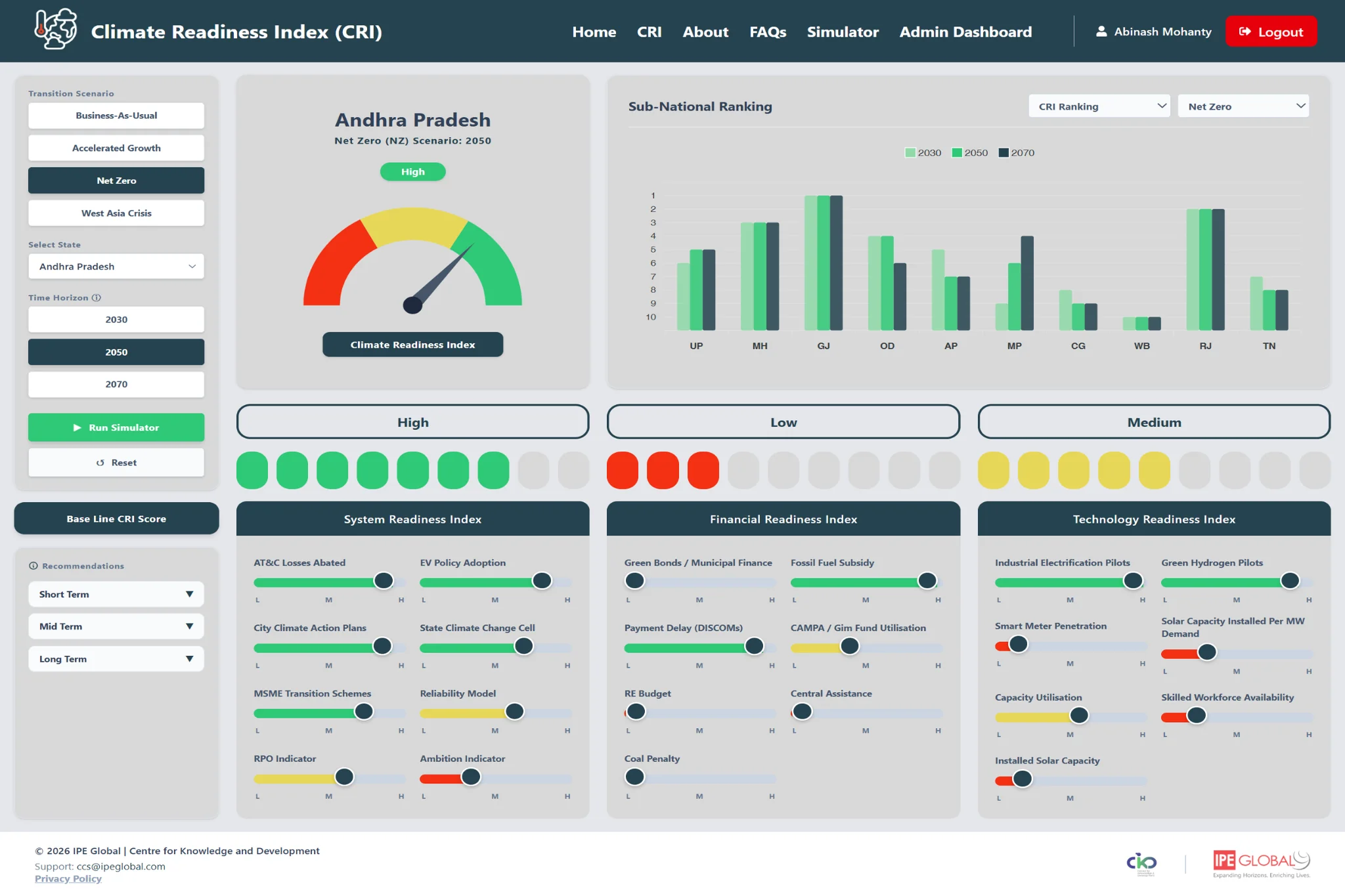
The assessment covers 10 of India’s highest greenhouse gas-emitting states: Uttar Pradesh, Maharashtra, Gujarat, Madhya Pradesh, Chhattisgarh, Rajasthan, Tamil Nadu, Andhra Pradesh, West Bengal and Odisha.
The project assesses climate readiness across three dimensions:
CRI Phase II uses a refined framework of 22 policy-relevant indicators spanning areas such as renewable energy planning, policy reliability, renewable energy finance, DISCOM performance, smart grids, industrial electrification, green hydrogen and workforce readiness. Historical trends are projected using indicator-specific statistical models and assessed under three transition pathways: Business-as-Usual (BAU), Accelerated Growth (AG) and Net Zero (NZ). Readiness trajectories are examined for 2030, 2050 and 2070, with the results integrated into the CRI-DSS.
The Climate Readiness Index Decision Support System (CRI-DSS) is the project’s key decision-support output. It provides an interactive interface through which users can compare states and scenarios, explore indicator-level drivers, track changes in readiness over time and identify priority areas for policy and investment.
The assessment finds that climate readiness varies considerably across states and that gaps persist across scenarios and time horizons. It also demonstrates that the factors constraining readiness differ by state, reinforcing the need for tailored interventions. The composite CRI assigns 64.8% weight to Systemic Readiness, 23% to Financial Readiness and 12.2% to Technological Readiness.
A separate 2030 solar deployment stress-test examined the implications of the West Asia crisis for renewable energy deployment. The analysis indicates a substantial additional solar deployment requirement to return to the modelled transition pathways, with Rajasthan, Gujarat and Maharashtra accounting for 69.1% of the total gap.
10 states | 22 indicators | 3 readiness dimensions | 3 transition scenarios | 3 time horizons (2030, 2050, 2070) | 1 CRI-DSS